
Table of Contents
- The Eternal Question: Karma vs. Destiny
- What Do the Vedas Say About Karma?
- Destiny in the Vedic Worldview
- The Three Types of Karma
- Karma and Free Will: The Human Role
- Bhagavad Gita’s Teaching on Action and Fate
- The Cosmic Balance: Fate Meets Effort
- Lessons for Modern Life
The Eternal Question: Karma vs. Destiny
Is our life already written somewhere in the cosmic script? Or do our choices shape the future? This debate — Karma vs. Destiny — has fascinated philosophers, seekers, and storytellers for thousands of years. Across cultures, people have wondered whether human beings are merely actors in a predetermined play, or whether we are authors of our own destiny.
In the Vedic worldview, the answer is neither extreme. Ancient Hindu philosophy presents a subtle and fascinating framework where both karma and destiny operate together, shaping the unfolding of human life. Understanding this dynamic requires diving into the wisdom of the Vedas, Upanishads, and the Bhagavad Gita.
What Do the Vedas Say About Karma?
The Sanskrit word karma simply means action. But in Vedic philosophy, karma carries a deeper meaning — every action creates consequences that ripple through time. This principle appears across many Hindu scriptures.
The Brihadaranyaka Upanishad explains this idea clearly: “A man becomes good by good action, and bad by bad action.” This simple statement contains a profound insight. Our choices do not disappear after we make them.
They create subtle impressions that influence our future experiences. In the Vedic worldview, the universe operates through a moral architecture of cause and effect, where actions eventually return to the doer. Thus, karma is not punishment. It is cosmic feedback.
Destiny in the Vedic Worldview
If karma governs consequences, then what is destiny?
In Vedic thought, destiny is often understood as the unfolding of past karma. The circumstances we are born into — family, environment, opportunities, and challenges — are believed to arise from actions performed in previous lives. This idea appears repeatedly in the Mahabharata and the Puranas.
Ancient sages described life as a journey where the soul carries a karmic ledger across lifetimes. What we experience today may not always be the result of actions performed in this lifetime alone. It may be the continuation of a much older story. In this sense, destiny is not random. It is the visible expression of invisible past actions.
The Three Types of Karma
Vedic philosophy goes even deeper by describing three categories of karma. These concepts help explain the relationship between karma and destiny.
1. Sanchita Karma
This refers to the accumulated karma from all past lives.
Think of it as a vast storage of actions and consequences waiting to unfold.
2. Prarabdha Karma
Prarabdha is the portion of karma currently shaping our present life.
Our birth circumstances, certain key events, and some life experiences fall into this category.
These are often considered part of destiny.
3. Agami Karma
Agami karma is the karma we are creating right now through our actions.
Every decision we make today contributes to future experiences.
This is where human freedom enters the equation.
Even if parts of life are influenced by past karma, our present actions still matter.
Karma and Free Will: The Human Role
One of the most fascinating insights of Vedic philosophy is that destiny does not eliminate human agency. Even within predetermined circumstances, individuals still possess choice. A famous analogy used by spiritual teachers explains it beautifully. Imagine life as a game of cards.
You do not control the cards you are dealt. But you control how you play them. The cards represent destiny. The way you play them represents karma.
Thus, while the past may shape the stage of life, our actions determine how the story unfolds.
Bhagavad Gita’s Teaching on Action and Fate
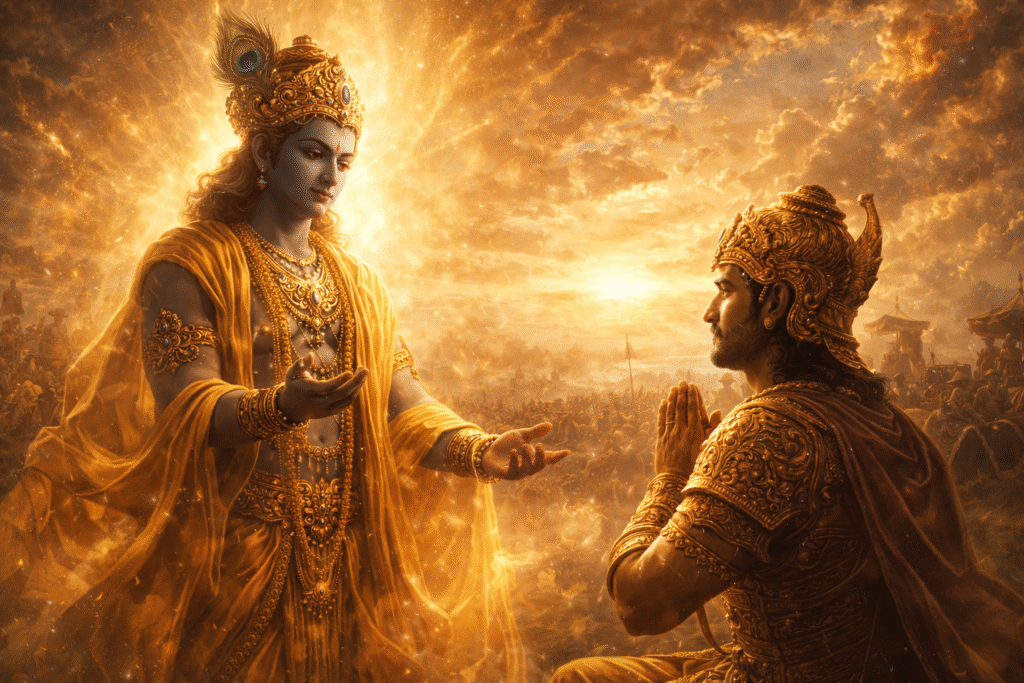
Perhaps the most famous explanation of karma vs. destiny appears in the Bhagavad Gita. During the Kurukshetra war, Prince Arjuna struggles with doubt and confusion. He wonders whether the outcome of life is already determined. In response, Lord Krishna delivers one of the most powerful teachings on action.
Krishna tells Arjuna:
“You have the right to perform your duty, but not to the fruits of your actions.”
— Bhagavad Gita
This teaching reveals a crucial insight. Humans control their actions, but not always their results. The results depend on many factors — past karma, the actions of others, and the broader cosmic order. The wisdom of the Gita encourages action without attachment.
Do your duty. Act with integrity. But do not become imprisoned by the expectation of specific outcomes.
The Cosmic Balance: Fate Meets Effort
When we combine these teachings, a balanced picture emerges.
In the Vedic worldview:
Destiny provides the starting conditions.
Karma determines the direction of movement.
Life is therefore not rigidly predetermined.
Nor is it completely random. Instead, it unfolds through a dynamic interaction between past actions and present choices. This balance explains why effort remains meaningful even in a universe governed by karma.
Lessons for Modern Life
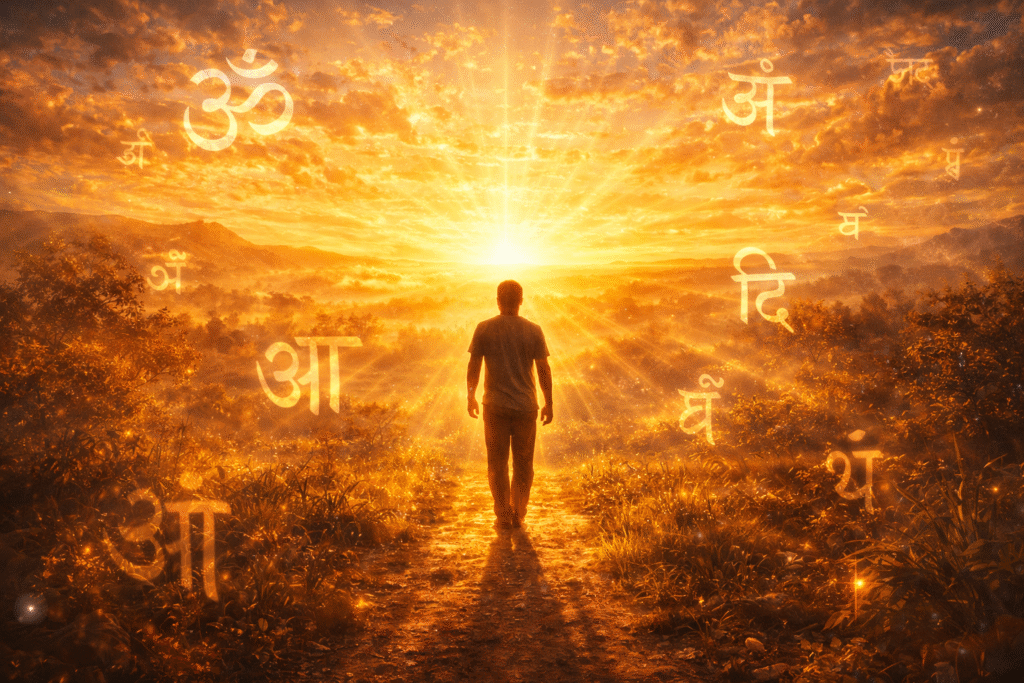
The ancient debate of karma vs. destiny remains surprisingly relevant today. Many people feel trapped by circumstances beyond their control.
Others believe that hard work alone can shape any outcome. Vedic philosophy offers a middle path. It reminds us that while we cannot control everything that happens to us, we always control how we respond.
Our actions, intentions, and attitudes continue to create new possibilities. In this sense, destiny is not a prison. It is simply the starting point of a journey. What we do next is still in our hands.
Final Reflection
The Vedic understanding of karma vs. destiny reveals a profound truth about human life. We are neither completely bound by fate nor entirely free from consequence. Instead, we live within a universe where action, responsibility, and cosmic law coexist.
The sages of ancient India did not see life as a fixed script. They saw it as an unfolding dialogue between the past we inherit and the choices we make today. And perhaps that is the deepest wisdom of all. Destiny may write the opening chapter. But karma continues to write the rest of the story.