
Introduction: The Timeless Mystery of Krishna’s Blue Form
Why Krishna is blue? This question has fascinated devotees, scholars, artists, and philosophers for centuries. Among the countless deities of the Hindu tradition, Lord Krishna stands apart not only for his divine roles—as child, lover, king, strategist, and teacher—but for a visual feature that defies biological logic: his blue complexion.
Human skin does not naturally appear blue. Melanin produces shades of brown, black, and tan, but never the deep indigo, cloud-dark, or celestial blue associated with Krishna. This immediately signals that Krishna’s form does not belong to ordinary biology. His color places him beyond the human realm and firmly within the symbolic and metaphysical universe of Vedic thought.
Across temples, manuscripts, miniature paintings, and modern art, Krishna’s skin appears in hues ranging from storm-cloud indigo to soft sapphire. This is not artistic coincidence. It is the result of layered meanings drawn from scripture, mythology, philosophy, psychology, physics, and material art history. To ask why Krishna is blue is to enter a multidimensional inquiry—one that spans poison and preservation, infinity and intimacy, cosmic law and human perception.
This article unpacks that mystery in full, drawing from the Srimad Bhagavatam, Brahma Samhita, Mahabharata, Yoga traditions, optical science, and art history, revealing why Krishna’s blueness is not decorative but doctrinal—a visual theology of the Infinite made intimate.
The Scriptural and Linguistic Roots Behind Krishna’s Color
Krishna vs. Shyama: The Sanskrit Color Paradox
To understand why Krishna is blue, we must begin with language itself. The Sanskrit word Krishna (कृष्ण) does not mean “blue” in the modern sense. It primarily means black, dark, or all-absorbing. It is the same word used for the dark lunar phase (Krishna Paksha) and the black antelope (Krishna-sara). Linguistically, Krishna signifies absolute darkness, not pigment but profundity.
Yet scriptures frequently describe Krishna as Shyama—a word meaning dark-hued, cloud-colored, or rain-laden. Shyama does not denote void-like blackness but a living darkness filled with promise, like a monsoon cloud heavy with rain. This distinction is crucial.
| Term | Meaning | Spiritual Implication | Visual Range |
|---|---|---|---|
| Krishna | Black, dark | Absolute, unknowable Brahman | Jet black |
| Shyama | Cloud-dark | Life-giving, intimate divinity | Indigo, deep blue |
| Neela | Blue | Infinity, sky, cosmic presence | Azure, cerulean |
The movement from Krishna (black) to Shyama (blue-dark) marks a theological transition—from Nirguna Brahman (formless absolute) to Saguna Bhagavan (loving, personal God). Pure black absorbs all light; blue reflects depth. Krishna must attract, play, and love—therefore, he cannot remain a void. Blue becomes the visible language of divine accessibility.
Brahma Samhita: The Cloud-Colored Lord
The Brahma Samhita (5.30) provides the most authoritative scriptural description of Krishna’s complexion:
asitāmbuda-sundarāṅgam — “whose body is beautiful like a dark rain cloud.”
The term asitāmbuda is precise:
- Asita — not white, dark
- Ambuda — water-giver, cloud
The text does not say Krishna is sky-blue. It says he is rain-cloud colored—a hue balanced between black and blue, charged with movement, fertility, and mercy. Anyone who has watched monsoon clouds understands this color instinctively. It is darkness that nourishes, not annihilates.
This description anchors all later artistic representations. Krishna is blue not because the scriptures say “paint him blue,” but because the closest human approximation to living, benevolent darkness is deep blue.
Yuga Theory: Why Krishna Appears Blue in Dvapara Yuga
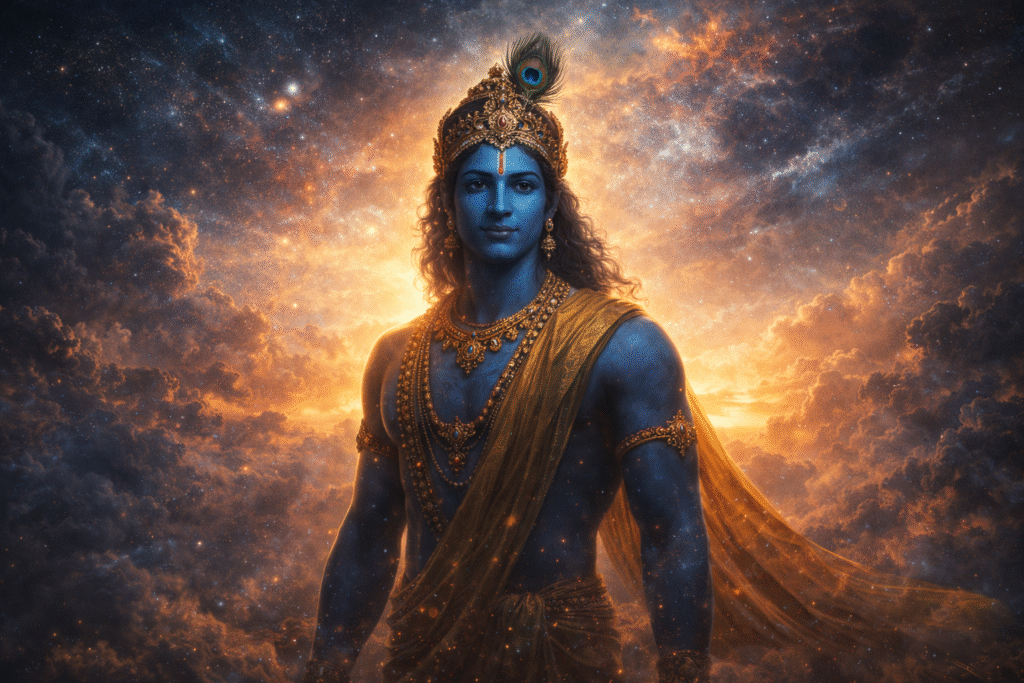
Vedic cosmology assigns different divine colors to different cosmic ages:
- Satya Yuga – White (purity, meditation)
- Treta Yuga – Red (sacrifice, ritual)
- Dvapara Yuga – Dark blue / Shyama (complexity, intimacy)
- Kali Yuga – Dark or concealed (spiritual obscuration)
Krishna appears in Dvapara Yuga, an age of emotional depth, conflict, passion, and moral struggle. The blue-dark complexion reflects an era where divinity must enter complexity without losing transcendence. Blue becomes the perfect medium—dark enough to engage the world, luminous enough to rise above it.
Mythological Explanations: Poison, Power, and Transformation
Putana and the Poisoned Milk
One of the most powerful myths explaining why Krishna is blue comes from the Putana episode. Putana, a demoness, attempts to kill infant Krishna by feeding him poison-smeared milk. Instead of dying, Krishna absorbs not only the poison but her life force.
In folk retellings, the poison permanently stains his body blue. Symbolically, this transforms blue into proof of divine immunity. Krishna does not reject poison; he absorbs and neutralizes it, wearing the world’s toxicity as a mark of victory—just as Shiva bears poison in his blue throat.
Kaliya and the Venomous Yamuna
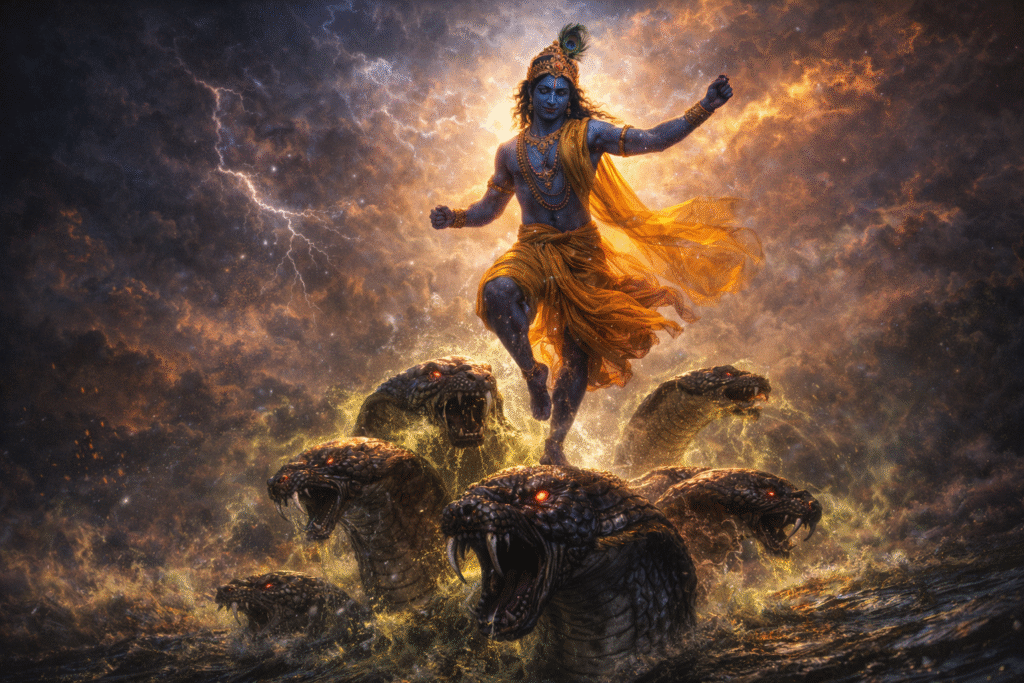
The serpent Kaliya poisons the Yamuna River, making it lethal. Krishna dives into the venomous waters, battles Kaliya, and dances upon his hoods. In popular lore, prolonged exposure to the serpent’s poison deepens Krishna’s blue hue.
Here, blue represents dominion over primal fear, death, and chaos. Krishna becomes the antidote, not by avoidance, but by immersion.
The Playful Color of Love
In Braj folklore, Krishna’s blue emerges not from battle but play. The Gopis smear him with indigo dyes during Holi or childhood games. Love itself colors him. In this telling, Krishna is blue because he is dyed in devotion, a canvas for human affection.
Philosophical Meaning: Infinity Made Visible
Ananta: The Color of the Infinite
Sages and modern thinkers alike converge on one insight: blue is the color of infinity. The sky is blue. The deep ocean is blue. Anything vast, immeasurable, and boundary-less appears blue to the human eye.
Sadhguru explains: “Blue is the color of all-inclusiveness.”
Swami Vivekananda echoed this: “Anything infinite appears blue to human perception.”
Krishna is blue because he is Ananta—endless, omnipresent, uncontainable. Painting the Infinite blue allows the finite mind to grasp what cannot be grasped.
The Blue Aura of Dynamic Stillness
In yogic traditions, blue signifies enlightened engagement. White withdraws from the world; blue acts within it without attachment. Krishna is the supreme Karma Yogi—fully involved in politics, war, love, and teaching, yet untouched by ego. His blue body represents action without bondage.
Science and Perception: Why Infinity Appears Blue
Rayleigh Scattering and the Blue Sky
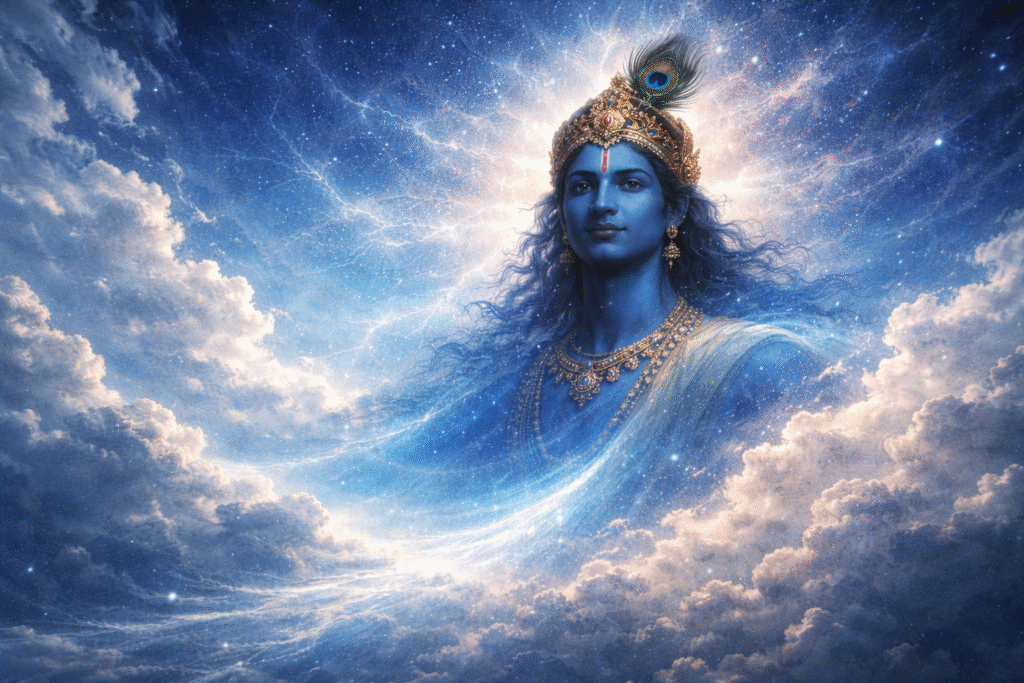
The sky appears blue due to Rayleigh scattering, where shorter blue wavelengths scatter more in the atmosphere. The infinite becomes visible through blue light.
This mirrors theology perfectly: the Infinite Brahman becomes perceptible through the “atmosphere” of Maya, appearing as Krishna’s blue form.
Why Not Violet?
Though violet scatters more, the human eye is more sensitive to blue. Krishna’s form aligns with human perception, not abstract physics. The divine reveals itself in the frequency humans can feel, not merely calculate.
Art History: From Black Stone to Blue Paint
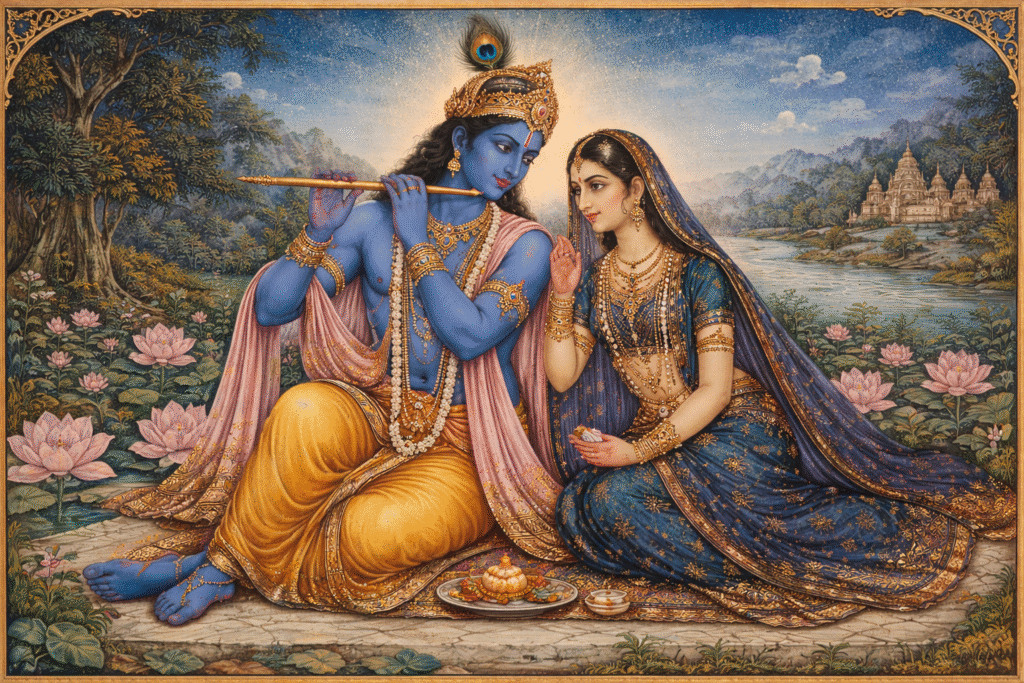
Early stone idols depicted Krishna as black due to material constraints. With the rise of miniature painting, artists faced a problem: black paint erased detail. Blue solved it.
Indigo, lapis lazuli, and later Prussian blue allowed artists to depict darkness with depth and luminosity. Over centuries, this aesthetic solution became theological canon.
Krishna did not become blue because artists misunderstood scripture. He became blue because blue was the only color capable of carrying darkness without destroying beauty.
Conclusion: Why Krishna Is Blue
So, why Krishna is blue?
Because blue is the only color capable of holding all these truths at once:
- The darkness of the Absolute
- The mercy of the rain cloud
- The infinity of sky and ocean
- The immunity to poison
- The calm of preservation
- The intimacy of love
- The vastness humans can perceive
Krishna’s blue is not pigment. It is philosophy made visible. It is the Infinite stepping into form without shrinking. When devotees look upon the Blue God, they do not see skin—they see sky, depth, refuge, and eternity.