
Karma vs. Destiny is the one question the human experience keeps circling: do we control our lives, or does life control us? This dilemma doesn’t just live in philosophy books—it shows up in everyday stress, regret, ambition, and fear. When things go well, we feel powerful; when tragedy strikes, we feel helpless. In the West, this debate often appears as free will vs. determinism. In the Vedic tradition, it becomes a deeper and far more practical tension: Karma vs. Destiny—the cosmic relationship between present action (karma) and the return of past actions as destiny (daiva).
Most people misunderstand both terms. Many treat destiny like a prison: a script written by a distant force, leaving them stuck in “Why me?” thinking. That mindset quietly breeds victimhood and destroys initiative. On the other side, modern motivation culture often sells the fantasy of total control—“manifest anything, anytime”—ignoring real constraints like health, environment, timing, and the choices of other people. That extreme also collapses, because when reality hits, it leaves a person feeling like a failure for not controlling what was never fully controllable.
The Vedic view offers a middle path that is both realistic and empowering. It suggests you are neither a puppet nor an all-powerful god. You are an archer holding a bow. You are a farmer working with seed and soil. You are a warrior inside your own mind where old conditioning fights new resolution. This article explores Karma vs. Destiny using the Mahabharata, the Bhagavad Gita, and the psychological depth of the Yoga Vasistha. The core insight is simple but life-changing: you may not control the cards you were dealt, but you have extraordinary power over how you play the hand. Destiny is not a future sentence—it is often frozen past effort. And present effort can melt it.
Understanding Karma vs. Destiny: Key Vedic Terms

Before we debate which is stronger, we must define what we are even talking about. Sanskrit terms carry layers of meaning that English translations often flatten. Once the terminology becomes clear, the entire discussion of Karma vs. Destiny becomes more practical and less mystical.
Karma (Action)
Karma comes from the root “Kr” (to do). In Vedic thought, karma is not merely “cause and effect” in a mechanical sense. Karma is volitional action, meaning it includes what you choose through your thoughts, speech, and deeds. In other words, karma is the engine that generates the future. Every conscious choice leaves an imprint. Some imprints strengthen clarity and discipline, while others strengthen anger, greed, fear, or laziness. This is why karma is not just a belief—it is a psychological law as much as it is a spiritual one.
Destiny (Daiva)
Daiva is commonly translated as fate or destiny, but it does not mean a divine script in the Abrahamic sense. In Vedic logic, daiva is simply your own past actions returning—often called purva-karma (previous karma). It is “unseen” (adrishta) because the cause is usually forgotten, so the effect appears to come from outside. That is why destiny feels like luck, misfortune, or random circumstance. But the Vedic point is subtle: destiny is not an enemy—it is karma ripening through time.
Purushartha (Self-Effort)
Purushartha means human initiative—the application of energy and intelligence in the present moment. If destiny is past momentum, purushartha is the living force that can redirect the future. It is the antidote to helplessness. Vedic sages consistently repeat that even though we are shaped by the past, we are not condemned by it. Purushartha is where agency lives, where character is built, and where inner evolution happens.
Why Karma vs. Destiny Matters for Your Mind
This debate isn’t abstract. Your belief about Karma vs. Destiny directly shapes your mental health. If you believe only in destiny, you slowly become passive. You stop trying, stop taking responsibility, and start tolerating what could have been changed. That mindset becomes tamasic: heavy, dull, lazy, resigned. It sounds spiritual on the outside—“It is written”—but it quietly becomes an excuse for surrendering your power.
On the other extreme, if you believe only in free will, you become harsh on yourself. You blame yourself for things that were never fully under your control—genetics, timing, economic collapse, family circumstances, accidents. That mindset becomes rajasic: restless, arrogant, anxious. It pushes people into burnout because they try to control outcomes that depend on countless factors outside the individual.
The Vedic solution is a sattvic balance: acknowledge the constraints created by the past, but champion the power of present effort. This is the mature view of Karma vs. Destiny—not denial of destiny, but refusal to worship it.
The Three Types of Karma That Explain Destiny
The debate of Karma vs. Destiny becomes confusing when people treat karma as one big block. Vedic seers did something far more precise: they mapped karma across time into three categories. This is the key to understanding what you can change, what you must endure, and where your power truly is.
The “Warehouse, Delivery Truck, Factory” Model
Imagine a business supply chain. There is inventory sitting in a warehouse, goods currently on a delivery truck, and a factory producing new items today. Karma works the same way—past storage, present delivery, and future creation.
Karma Types at a Glance
- Sanchita Karma: accumulated karma from many lifetimes (the warehouse)
- Prarabdha Karma: karma currently unfolding as this life (the delivery truck / arrow in flight)
- Agami (Kriyamana) Karma: karma you create now (the factory / arrow in hand)
This framework makes Karma vs. Destiny extremely clear: destiny is mostly prarabdha, while your freedom exists mainly in agami.
Sanchita Karma: The Accumulated Reservoir
Sanchita means “piled up.” It is the vast storehouse of impressions (samskaras) built through countless actions over many lifetimes. Some impressions are beneficial (punya), others harmful (paapa). These impressions wait for the right environment to express themselves—just like seeds wait for the right season. You may have the karmic potential to become a musician, scholar, leader, or healer, but if the conditions of birth don’t support it, that seed can remain dormant for an entire lifetime.
Sanchita is too vast to exhaust simply by “experiencing” it. The Vedic approach teaches that sanchita is burned not through suffering but through inner clarity, self-knowledge, and deep transformation. When ignorance dissolves, the warehouse loses its power.
Prarabdha Karma: Destiny You Must Experience
Prarabdha is the portion of sanchita selected to shape this particular life. It determines your parents, body type, natural tendencies, genetic predispositions, and many major circumstances you did not choose consciously. This is what most people mean when they say “my destiny.”
The crucial point: prarabdha cannot be undone once activated. You cannot reverse the arrow already released. You cannot choose to be taller after birth. You cannot undo certain inherited conditions. This is why the Vedic tradition emphasizes acceptance—because resisting prarabdha wastes energy and creates unnecessary suffering. Acceptance is not weakness; it is strategic sanity.
Agami Karma: The Zone of Power
Agami (also called kriyamana) is the karma you create right now. Your present choices are shaping future consequences, either later in this life or as new seeds in the storehouse. Even reading this article creates karma—your attitude while reading strengthens either clarity or resistance, either openness or cynicism.
This is where the debate ends: you have zero control over yesterday (prarabdha), but you have real control over today (agami). This is why Vedic wisdom never allows the excuse of helplessness.
The Archer Analogy: A Master Key for Karma vs. Destiny

One of the most vivid explanations of Karma vs. Destiny is the archer metaphor found in Vedantic tradition and commentaries. It presents the individual (jiva) as a warrior with a bow, and karma as arrows in different states.
The Three Arrows
The Quiver: Sanchita Karma
The quiver on the archer’s back is full of arrows. These represent dormant karmic possibilities. They are burdens, but they are not yet active. The archer may never use many of them. This illustrates a powerful point: not all stored karma must manifest. Some seeds remain unused when life conditions never match them, or when inner transformation burns them.
The Arrow in Flight: Prarabdha Karma
One arrow has already been released. It is flying toward its target. Once released, the archer cannot pull it back. He cannot argue with physics. Momentum, wind, and gravity now govern the arrow. This is prarabdha. The moment you were conceived, the arrow of this life was shot. Certain circumstances will unfold whether you like them or not.
The lesson is firm: do not waste energy trying to stop the arrow in flight. Regret, denial, or resentment only drains strength that should be used for the present.
The Arrow in Hand: Agami Karma
Now the archer holds a fresh arrow. He can aim. He can change targets. He can delay. He can even snap the arrow. This is agami—your living zone of choice. In this single image, the truth of Karma vs. Destiny becomes clear: destiny is the arrow already flying, and free will is the arrow still in your hand. Both exist at the same time.
The Tiger Scenario: Destiny vs Response
Imagine walking through a forest when a tiger attacks. In this metaphor, the tiger represents prarabdha—an event already present. You cannot “manifest away” the tiger. It is there. But your response is agami.
- If you surrender—“it’s my destiny”—you freeze, and you die.
- If you act—run, climb, fight—you may survive.
Even if death is written, Vedic texts insist you must act. Why? Because you do not know the full content of destiny. Often destiny is conditional: “survival if he runs.” If you refuse to act, you fail to activate the survival clause. This is why Vedic wisdom trains effort, not helplessness.
The Archer’s Inner State
A drunken archer shoots badly and creates more problems. Likewise, a mind intoxicated by ignorance produces messy karma. A master archer acts with precision, accepts the arrow in flight, and focuses on the arrow in hand. This is the yogic attitude: calm acceptance of destiny, fierce discipline in action, and reduced ego in outcomes.
Yoga Vasistha: The Psychological War Behind Karma vs. Destiny

The archer analogy explains events, but the Yoga Vasistha goes deeper—it targets the mind itself. In this dialogue between Sage Vasistha and Lord Rama, the text destroys victim mentality with sharp logic and offers a radical emphasis on self-effort (purushartha).
The Myth of “External Fate”
Vasistha challenges the idea that destiny is a separate supernatural force controlling your life. He argues that people invent “fate” to comfort themselves when they fail. If everything were controlled externally, why would anyone chew food, walk, or lift a hand? The body responds to will. Life also responds to will, though not always instantly.
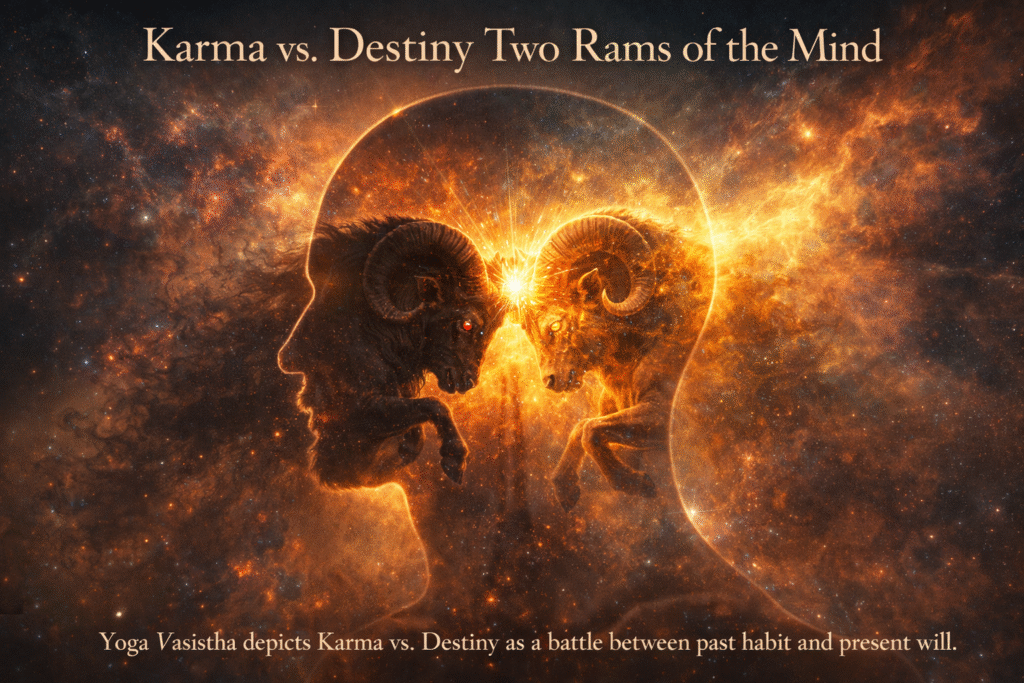
The Two Rams Analogy
Vasistha describes the mind as a battlefield between two rams locking horns:
- Ram of Destiny (Past Conditioning / Purva-Vasana): old habits, addictions, tendencies, genetic impulses, emotional patterns built through repetition.
- Ram of Effort (Present Resolution / Purushartha): fresh awareness, discipline, wisdom, and deliberate change.
Who wins? Vasistha’s answer is blunt: the stronger ram wins. There is no magic, no shortcut, no divine rescue. If your past habit is stronger than your present discipline, you fall. If present effort becomes stronger, you rise.
“Gritting Teeth”: How Change Happens
The Yoga Vasistha gives brutally practical advice: if you keep failing, it simply means your present effort is not yet intense enough. Increase it. Forcefully. “Grit your teeth,” override the impulse, and persist. Over time, the living force of effort weakens the dead momentum of past habit. This is how Karma vs. Destiny turns from philosophy into daily practice.
The River Metaphor: New Effort Becomes New Destiny
The mind is like a river flowing in an old channel. Past habit is the channel. Present effort is digging a new trench. At first, the water resists. But if you block the old path and persist with the new, the river eventually flows naturally into the new channel. Then what once required effort becomes effortless—and the new effort becomes the new destiny.
The Mahabharata’s Verdict on Karma vs. Destiny
The Mahabharata addresses Karma vs. Destiny not as a theory but as an ethical reality. In the Anushasana Parva, Yudhishthira asks Bhishma directly: Which is superior—destiny or exertion? Bhishma answers by quoting a dialogue between Sage Vasistha and Lord Brahma, suggesting the verdict comes from the highest cosmic authority.
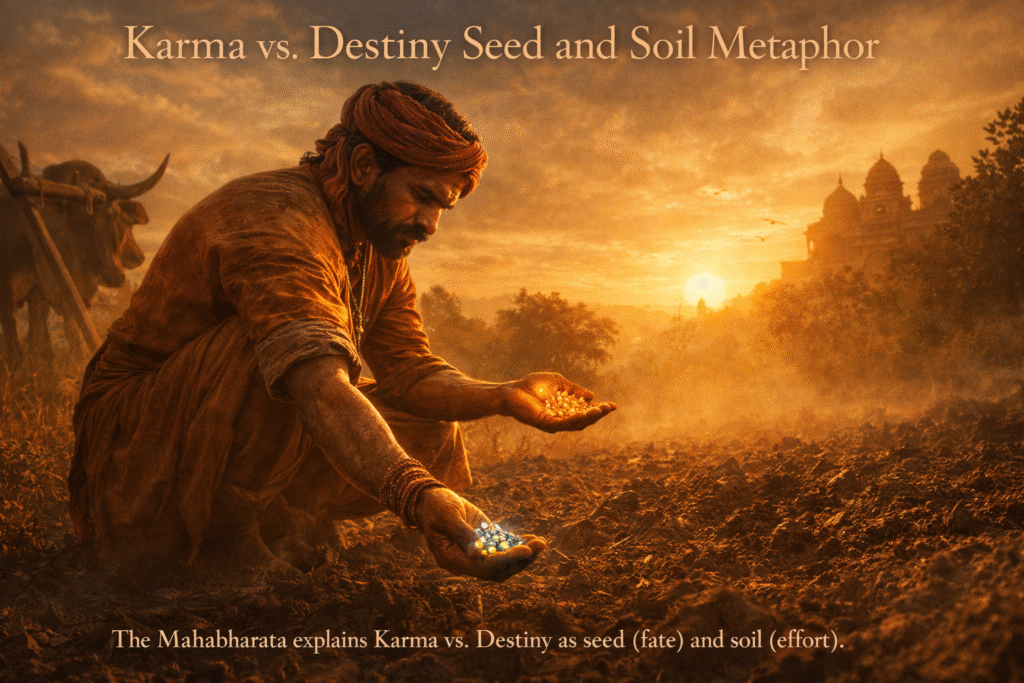
The Farming Analogy: Seed and Soil
Brahma explains that destiny is like a seed and effort is like soil. The harvest comes from both, but he emphasizes something important: soil leads. Even a powerful seed fails in barren soil. Even an average seed performs well in rich, cultivated soil.
- Seed (Destiny): your potential, birth conditions, innate tendencies.
- Soil (Effort): your discipline, practice, learning, decisions.
The conclusion is clear: without effort, destiny is of no use.
Destiny Follows Effort Like a Shadow
Brahma gives a striking image: destiny follows effort as a shadow follows the body. The shadow cannot move by itself. It moves when the body moves. Similarly, destiny cannot produce results unless action triggers it. This positions purushartha as leader and daiva as follower in the reality of Karma vs. Destiny.
Draupadi’s Fire: Rejecting Passive Destiny
In the Vana Parva, Draupadi challenges Yudhishthira when he becomes too resigned. She argues that God acts through human agents and that relying only on destiny is weakness. Yet she also acknowledges that outcomes depend on forces beyond us—like rain after ploughing. The farmer must plough regardless. If rain doesn’t come, he is not to blame. But if he never ploughs, he has already failed. This is the mature synthesis of Karma vs. Destiny.
The Bhagavad Gita: The Operational Manual of Karma vs. Destiny
The Bhagavad Gita is the moment when the archer—Arjuna—drops his bow. He sees the overwhelming force of destiny and collapses emotionally. Krishna’s teaching is the ultimate corrective: act fully, detach from results, and align effort with dharma.
Gita 2.47: Your Right Is Action
Krishna states that you have authority over action, not over results. The result depends on countless factors—other people’s karma, timing, environment, chance, and unseen variables. Detachment is not indifference. It is psychological protection. When you stop obsessing about outcomes, you become more effective in action. This is the most practical teaching in Karma vs. Destiny: control the arrow, not the target.
Gita 18.14: The Five Factors Behind Every Outcome
Krishna breaks every event into five components:
- The field (body/environment)
- The doer (ego/agent)
- The instruments (tools/mind/senses)
- The effort (activity)
- Destiny (unknown factor)
Destiny is only one factor, not the whole equation. Fatalism gives 100% power to factor five. Karma Yoga maximizes the first four. This explains why effort often overrides bad luck—and why laziness wastes good luck.
“Nimitta Matram”: Be the Instrument
Krishna says the warriors are already slain by time, and Arjuna must be the instrument. If destiny is already set, why act? Because action purifies Arjuna. Destiny will unfold with or without him, but his participation shapes his inner evolution. If he runs, the war still happens, but he gains the karma of cowardice. If he acts, he aligns with dharma and grows. This is the deeper layer of Karma vs. Destiny—your outer outcome may be limited, but your inner growth is always in your hands.
Case Studies: When Self-Effort Rewrites Destiny
The Vedic tradition doesn’t only preach theory; it provides living case studies showing how intense effort challenges destiny.
Markandeya: The Boy Who Defeated Death
Markandeya was destined to die at sixteen. The arrow was in flight. Instead of surrendering, he intensified spiritual effort and devotion to Shiva. When Yama arrived, Markandeya clung to the Shiva Lingam with such force of tapas and surrender that Shiva intervened. The symbolic lesson is profound: when effort rises to spiritual intensity, it can burn through what appears fixed.
Savitri: Arguing With the Inevitable
Savitri knowingly married Satyavan despite a prophecy of his death. She didn’t wait helplessly. She used vow, discipline, and unwavering presence. When death came, she followed and debated dharma with Yama, winning back her husband. The message is clear: destiny is not always a final decree—sometimes it is a challenge that demands a higher level of effort.
Vishwamitra: Breaking the Identity of Birth
Vishwamitra was born a king but aspired to become a Brahmarishi. Social structure said it was impossible. But he proved that birth identity is not the final authority. Through thousands of years of tapas—failures, temptations, rage, discipline—he transformed himself. The larger lesson: effort can rewrite what society calls destiny.
Practical Application: A Daily Algorithm for Karma vs. Destiny
How do we convert this deep discussion into something usable in real life? The Vedic approach is simple: accept what is already unfolding, and act powerfully where action is possible.
The Card Game Mindset
Destiny is the cards you are dealt. Effort is how you play the hand. A master can win with weak cards. A fool can lose with strong ones. The goal is not only external success but playing your hand with dharma—clarity, courage, and discipline.
The Feedback Loop Protocol
When something painful happens—job loss, betrayal, setback—treat it as feedback rather than “bad luck.” Some of it may be prarabdha ripening. Don’t waste energy cursing the arrow in flight. Pivot immediately to the arrow in hand: upgrade skills, network, rebuild, adapt. Action is the spiritual response.
The “20% Reality Check”
When effort fails, remember the five factors. You controlled your part. Destiny did what it did. This reframes failure into maturity: “I did my responsibility; the rest is not mine.” This prevents depression and keeps your mind stable.
Strengthening the Good Ram
Identify your strongest past habits—anger, laziness, addiction, fear. Don’t hate yourself; those are conditioned rams fed over time. Then feed the present ram: discipline, friction against bad habits, ease toward good habits. Override impulses “perforce” until the river changes its channel.
Conclusion: The Sovereign Self in Karma vs. Destiny
The deeper you study Vedic wisdom, the clearer the conclusion becomes: Karma vs. Destiny is a false war when understood correctly. Destiny is not your enemy. Karma is not a fantasy. Destiny is the ground you stand on; karma is the step you take. You cannot walk without ground, but the ground does not dictate where you walk.
The Mahabharata warns that those who rely only on destiny are destroyed. The Bhagavad Gita commands action without fear of results. The Yoga Vasistha insists that present effort, persisted in, is stronger than past momentum. You are the archer with the bow in your hand. The wind may blow, the target may move, circumstances may resist—but the aim, the draw, and the release are still yours.
Do not stare at the arrow in the sky with regret.
Look at the arrow in your hand with purpose.
That is the essence of Karma vs. Destiny—you endure your yesterday, but you still create your tomorrow.