
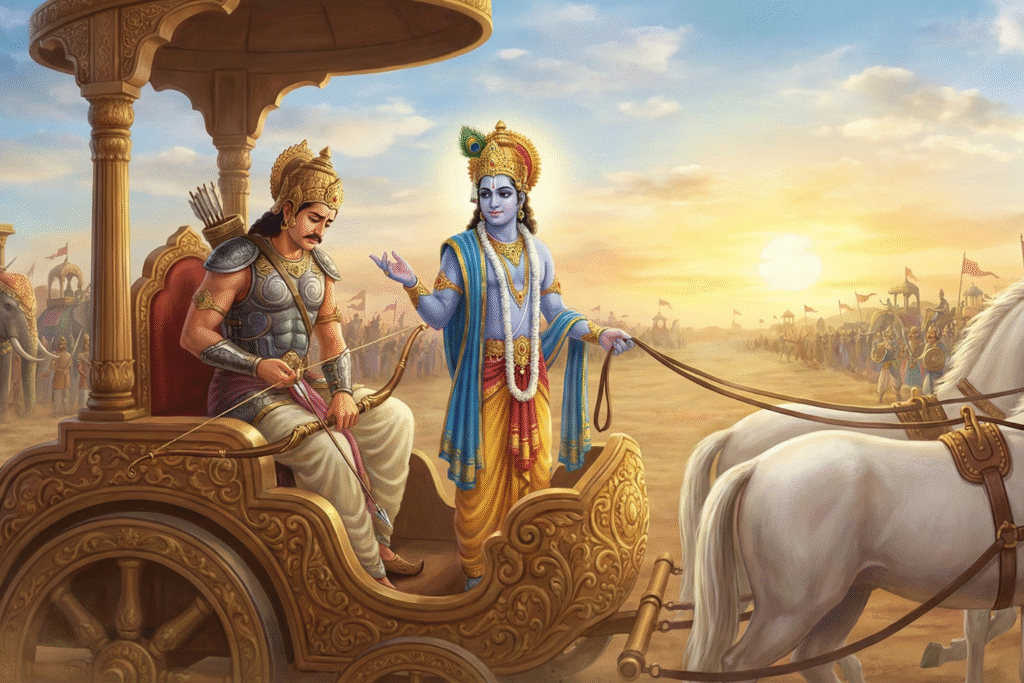
Mahabharata’s Life Lessons come alive on a battlefield at dawn. Imagine Arjuna, the mighty warrior, standing in his chariot with trembling hands and a heavy heart as he faces an army of loved ones. In that tense moment, his mind spirals with anxiety and doubt. He feels paralyzed by the thought of waging war against his own kin.
This vivid scene from the ancient Indian epic isn’t just a story about gods and kings. It’s a mirror to our inner world. We all fight battles within ourselves: struggles between duty and emotion, courage and fear, ego and morality.
That’s why mythology meets psychology in the Mahabharata, revealing timeless life lessons for our modern minds. Today, more people are turning to this epic for mental health and leadership guidance. They see their own dilemmas reflected in Arjuna’s indecision or Yudhishthira’s ethical trials.
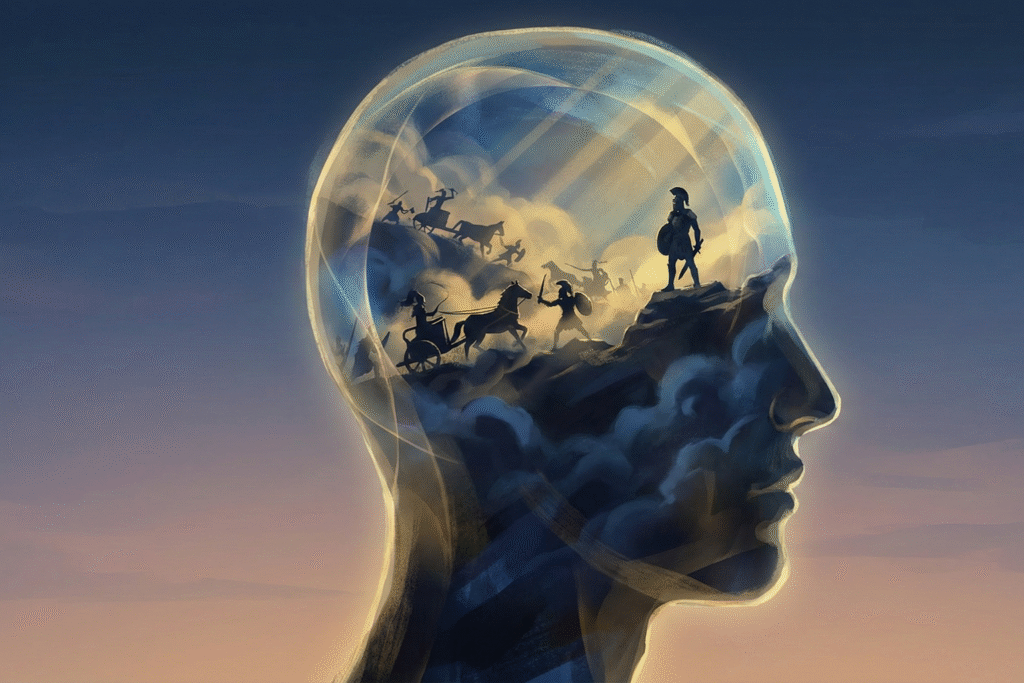
The Kurukshetra war of the Mahabharata isn’t merely an ancient clash. It symbolizes the war within each of us — the daily conflict between our higher aspirations and darker impulses. By understanding these characters and conflicts, we uncover practical insights into anxiety, duty, anger, and integrity. These are lessons that typical mythic retellings often overlook.
(Why does this matter? Because the Mahabharata isn’t just about ancient heroes — it’s about you. Every victory and defeat in the epic hints at a lesson for conquering the battles in your own life.)
Table of Contents
- Arjuna’s Indecision – Mahabharata’s Life Lessons on Anxiety and Duty
- Bhima’s Fury – Mahabharata’s Life Lessons on Strength and Passion
- Yudhishthira’s Moral Struggle – Mahabharata’s Life Lessons on Integrity
- Dhritarashtra’s Blind Attachment – Mahabharata’s Life Lessons on Ego and Denial
- The War Within – Mahabharata’s Life Lessons for Your Inner Kurukshetra
- FAQs on Mahabharata’s Life Lessons
- Conclusion
Arjuna’s Indecision – Mahabharata’s Life Lessons on Anxiety and Duty
On the morning of the Kurukshetra war, Arjuna experiences what we’d recognize today as a panic attack. The Bhagavad Gita describes his legs shaking, mouth dry, and mind reeling as he lowers his bow in despair holy-bhagavad-gita.orggitadaily.com. Arjuna feels completely overwhelmed by anxiety and moral doubt. How often do we face a similar mental battle — frozen by overthinking when a tough decision looms?
In the Mahabharata, Arjuna’s crisis teaches that even the bravest heroes can struggle with anxiety and indecision. Crucially, Arjuna doesn’t bottle up his feelings; he voices them to Krishna, his charioteer and dear friend. This openness to seek guidance becomes his saving grace. Krishna’s counsel in the Gita isn’t about urging blind violence; it’s a therapy session on wheels, guiding Arjuna through his inner turmoil.
“Krishna does not simply counsel Arjuna to fight an external war; he guides him to confront his inner paralysis, moral confusion, and suppressed aggression,” as one analysis notes meda.foundation. The life lesson here is twofold: face your fears head-on and seek wise counsel. Arjuna’s story reminds us that feeling anxious when duty calls is natural. However, by confronting our doubts (instead of running away) and asking for help, we can find clarity.
In modern life, whether it’s a major career move or a personal dilemma, the cure for paralysis is action guided by wisdom. Arjuna transformed his anxiety into focused courage once he reframed the battle as a righteous duty. Mahabharata’s Life Lessons from Arjuna inspire us to listen to our inner Krishna (conscience or mentor) when anxiety clouds our purpose.
Bhima’s Fury – Mahabharata’s Life Lessons on Strength and Passion
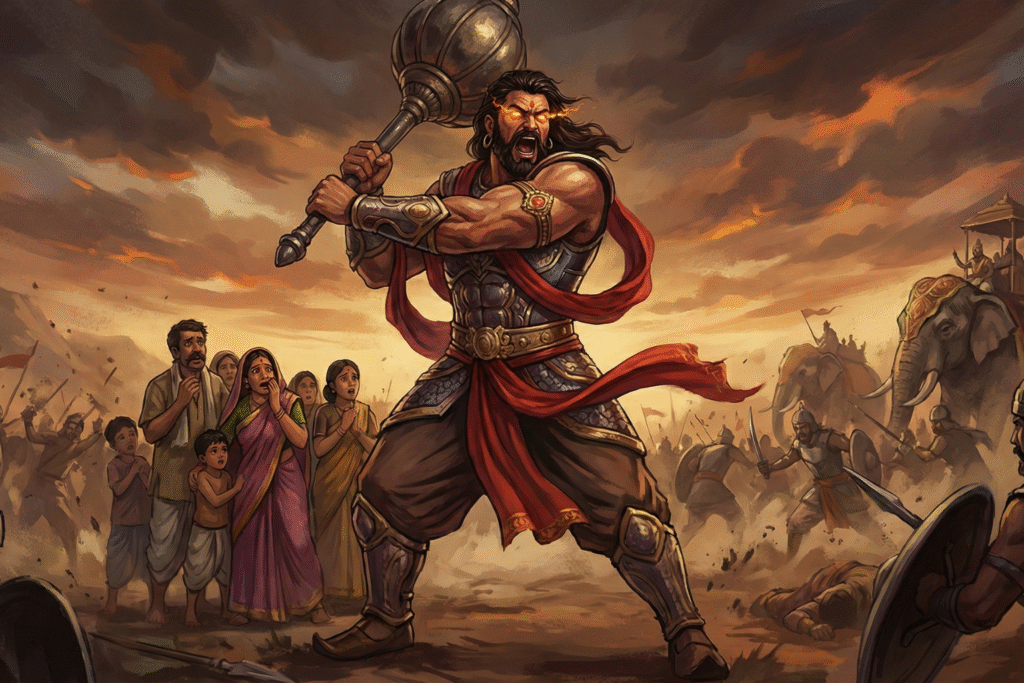
Where Arjuna is thoughtful and hesitant, his brother Bhima is all ferocity and passion. Bhima, the strongest of the Pandavas, has an almost elemental fury. He famously vows to crush the villainous Kauravas for their injustices. In the epic, Bhima’s anger is a double-edged sword. It gives him the power to fight evil, but unchecked anger can also lead to rash actions. How does Bhima’s character mirror our psychological archetype of raw strength and impulsiveness?
Think of times when anger has boiled in you — maybe at unfair treatment or betrayal. Bhima’s life lesson is that anger can be righteous fuel or a ruinous fire depending on how we harness it. The Mahabharata shows Bhima channeling his rage toward just causes like defending honor and punishing wrongdoers. He does this under the guidance of dharma (moral duty).
Yet, Bhima also has to learn restraint. He carries the weight of his vows responsibly. For instance, he waits years to fulfill his oath of vengeance until it aligns with the greater good. In a modern context, Bhima teaches us about balancing passion with principle.
Our inner Bhima is that passionate drive that can help us overcome obstacles (like standing up to bullies or fighting for justice). However, unbridled fury can backfire. Mahabharata’s Life Lessons from Bhima urge us to acknowledge our anger but not be blinded by it. Instead, we transform anger into courageous action. This might mean speaking up against wrongdoing, but doing so with a clear mind.
The focus should be on solutions rather than revenge. By embracing Bhima’s strength — bold, loving, and tempered by wisdom — we learn that true power is controlled power. As the saying goes, “anger is an energy.” Bhima shows us how to direct that energy to protect the right and defeat the inner demons of fear and weakness.
Yudhishthira’s Moral Struggle – Mahabharata’s Life Lessons on Integrity
Yudhishthira, the eldest Pandava, is celebrated as a pillar of integrity – so much that he’s called Dharmaraja, the king of righteousness. But even Yudhishthira’s journey is fraught with moral struggles and hard lessons.
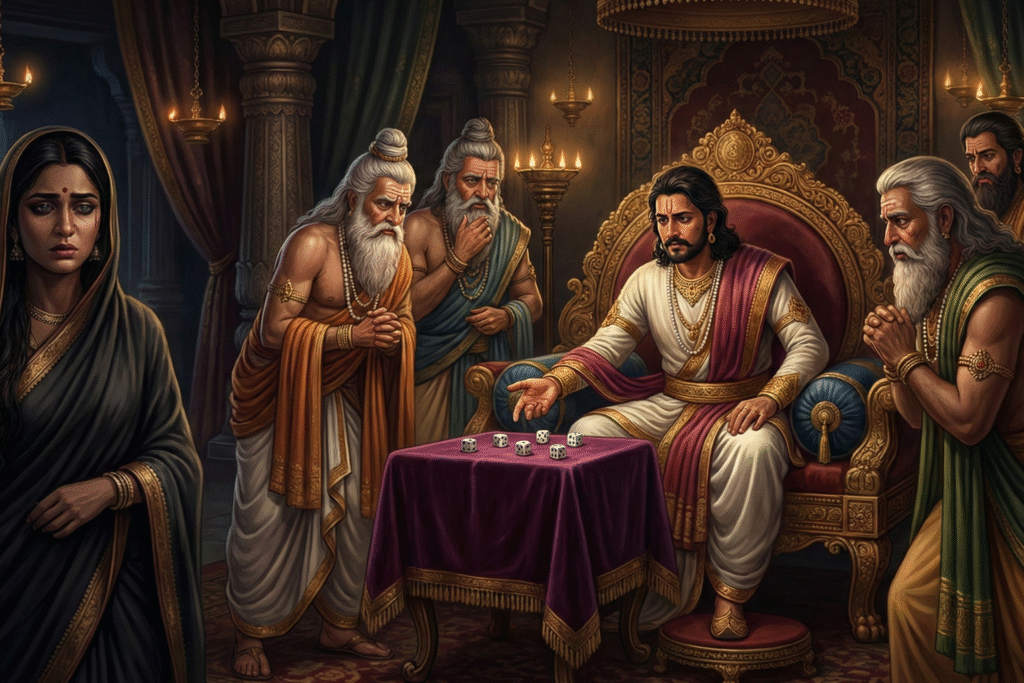
One of the most striking episodes is the disastrous game of dice. Coaxed by his cunning cousins, Yudhishthira gambles away his kingdom, his wealth, and even his wife Draupadi, plunging his family into years of exile. How could the emblem of virtue fall prey to such a vice?
The Mahabharata portrays Yudhishthira’s flaw as an obsession with upholding honor and sticking to his word – qualities that villains like Shakuni exploit. His attachment to being infallibly righteous becomes his blind spot meda.foundationmeda.foundation. This reveals a profound life lesson: even good people have weaknesses, and unexamined virtue can turn into vanity or folly. Yudhishthira learns humility and self-awareness the hard way.
Later in the epic, after the great war, he faces despair and guilt despite “winning.” The carnage wrought in the name of duty leaves him questioning whether the ends justified the means – a feeling many of us recognize after making a painful but necessary choice.
Through Yudhishthira, Mahabharata’s Life Lessons teach us that integrity isn’t about never failing. It’s about learning from failures and staying true to your core values even when you falter.
He redeems himself by caring for his fallen enemies’ families and seeking wisdom from elders on how to rule justly. In one poignant finale, Yudhishthira refuses to abandon a loyal dog while trekking to heaven, valuing compassion over celestial reward.
The takeaway? Ethical living is a constant battle of discernment, and true integrity balances justice with mercy. In our lives, when we face ethical dilemmas – whether to speak a harsh truth or tell a soft lie, whether to stick to principles or adapt – Yudhishthira’s inner struggle reminds us to check our ego, admit our mistakes, and keep striving for righteous action with a humble heart.
Dhritarashtra’s Blind Attachment – Mahabharata’s Life Lessons on Ego and Denial
Not all of Mahabharata’s Life Lessons come from heroes; some come from the tragic mistakes of its flawed figures. King Dhritarashtra offers a cautionary tale about the blindness of ego and attachment.
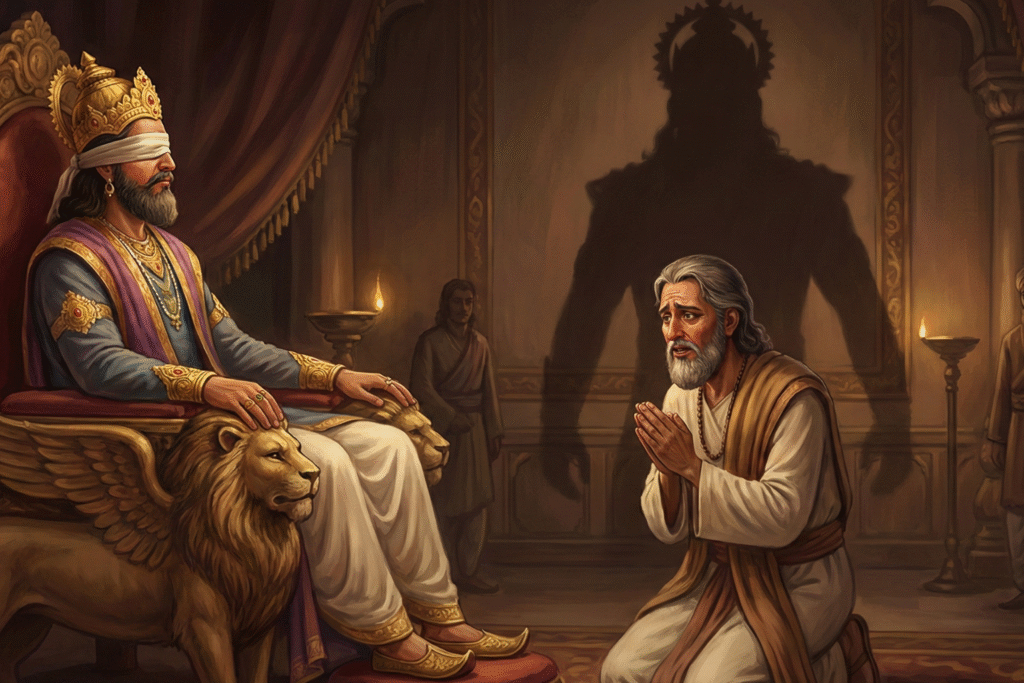
Born physically blind, Dhritarashtra is also blinded by paternal love and ambition. He cannot see the evil in his son Duryodhana’s heart, even as the prince’s envy and arrogance drive the kingdom toward catastrophe.
Throughout the epic, Dhritarashtra repeatedly ignores wise counsel – from his brother Vidura and others – because he can’t bear to curb his son’s desires. Psychologically, Dhritarashtra represents the part of us that denies unpleasant truths. His literal blindness is a powerful metaphor for emotional blindness: turning a blind eye to wrongdoing out of selfish attachment.
We’ve all been there in small ways, haven’t we? It’s like ignoring red flags in a loved one or clinging to a harmful habit because we’re too attached to let go. The life lesson from Dhritarashtra’s downfall is stark: clinging to ego and ignoring truth leads to destruction. His refusal to discipline Duryodhana results in a war that wipes out nearly his entire family.
In modern terms, this warns leaders against nepotism and parents against blind indulgence, but it also speaks to each of us about confronting our inner denials. The Mahabharata invites us not to be like Dhritarashtra — instead, we must summon the courage to face reality, even when it hurts.
Had Dhritarashtra acknowledged his son’s flaws and his own attachment, he might have averted the tragedy. Likewise, we win our inner battles by opening our eyes to truth. Mahabharata’s Life Lessons implore us to shed the blindfold of denial. Whether it’s admitting a mistake, recognizing a toxic relationship, or accepting a hard fact about ourselves, seeing clearly is the first step to setting things right.
As the saying goes, “the truth may hurt for a little while, but a lie (or denial) hurts forever.” Dhritarashtra’s legacy in the epic is a permanent reminder that honesty with oneself is a non-negotiable virtue if we wish to avoid self-inflicted disaster.
The War Within – Mahabharata’s Life Lessons for Your Inner Kurukshetra
Why do these ancient tales of warriors and kings feel so personally relevant? Because the Mahabharata is more than a historical saga — it’s a spiritual and psychological guide.
Every character we meet is like a fragment of our own psyche. In fact, “each key figure in the Mahabharata is a richly drawn psychological archetype…mirrors reflecting back the hidden recesses of our inner world,” as one scholar observes.
The furious Bhima, the anxious Arjuna, the upright Yudhishthira, the blind Dhritarashtra – they live within us as archetypal energies. The epic’s great battlefield, Kurukshetra, is really a grand metaphor for the battlefield of the mind. Each day, within our hearts, a war rages between love and hate, duty and temptation, confidence and doubt.
The Mahabharata encourages us to recognize this inner Kurukshetra. Instead of viewing the epic as a distant legend, we can read it as a map of our own inner conflicts. For example, when we feel torn between what’s right and what’s easy, we’re like Arjuna – bow trembling as he decides whether to fight his own attachments. Similarly, when our ego inflates with pride or anger, Duryodhana or Bhima might be taking the reins inside us.
By reading these characters symbolically — as internal facets rather than external figures — we unlock the epic’s greatest gift: a mirror to self-awareness meda.foundation. This perspective is empowering. It means every time we hear of a triumph or downfall in the Mahabharata, we can ask: “Where is this playing out in my life?”
Do I need to summon Krishna’s wisdom to mediate my internal disputes? Perhaps practice the patience of Yudhishthira, or the righteous anger of Draupadi when faced with injustice? This internalization of mythology transforms ancient life lessons into modern self-help tools. It’s like having a council of epic heroes inside your head, guiding you through life’s challenges.
Ultimately, Mahabharata’s Life Lessons urge us to become the heroes of our own story. By acknowledging the Kurukshetra within, we grow from inner conflict toward inner harmony — integrating our shadows and virtues, and emerging wiser and more whole.
FAQs on Mahabharata’s Life Lessons
Q: What are Mahabharata’s Life Lessons for modern readers?
A: Mahabharata’s Life Lessons for today’s world include conquering inner weaknesses, upholding dharma (ethical duty) even when it’s hard, and understanding the consequences of ego, anger, and attachment. The epic teaches practical wisdom: Arjuna shows how to overcome self-doubt with guidance,
Yudhishthira exemplifies learning from mistakes to stay virtuous, and even negative characters like Duryodhana warn against the ruin of unchecked greed and pride. In essence, the Mahabharata urges us to act with courage, integrity, and empathy in our own life battles.
Q: Which Mahabharata character teaches us about dealing with anxiety and doubt?
A: Arjuna is the prime example of grappling with anxiety and doubt. At the brink of the great war, he experiences intense panic and indecision about fighting. Through his dialogue with Krishna in the Bhagavad Gita, Arjuna learns to center himself, understand his duty (svadharma), and act without attachment to outcomes.
His journey is like a lesson in overcoming an anxiety attack through wisdom and mindfulness. Arjuna’s story reassures us that feeling doubt doesn’t make us weak – it’s an opportunity to seek clarity and do what’s right despite fear.
Q: How does the Mahabharata relate to psychology and the “inner self”?
A: The Mahabharata can be seen as a study of the human mind and behavior. Modern psychology identifies concepts like the shadow self (our hidden flaws) and archetypes (universal character patterns), and the Mahabharata anticipated these ideas ages ago.
Characters in the epic personify emotions and traits – for instance, Dhritarashtra’s denial, Draupadi’s righteous fury, or Karna’s lifelong loneliness – which mirror psychological realities in all of us. By reflecting on these characters, we gain insight into our own psyche. It’s almost like a Jungian analysis in story form: the epic dramatizes inner conflicts, teaching us about ourselves in the process.
Q: Why is the Mahabharata relevant for self-help and personal growth?
A: Despite being thousands of years old, the Mahabharata remains deeply relevant because it addresses fundamental human struggles: making tough choices, dealing with family conflicts, resisting temptation, and pursuing one’s purpose. It offers not just moral lessons but also emotional guidance. For example, it shows how unchecked anger or jealousy can destroy lives (think of Duryodhana), and how forgiveness and humility can heal (as seen when the Pandavas seek peace even after winning).
Many people today turn to the Mahabharata and the Bhagavad Gita for inspiration in leadership, conflict resolution, and mental resilience. The stories serve as a powerful reminder that others have fought these inner battles before and triumphed, so we can too. In a way, the Mahabharata is like an ancient self-help manual wrapped in an epic saga – it helps us reflect, grow, and become better versions of ourselves.
Conclusion
The Mahabharata may be an ancient epic, but its wisdom is evergreen. Mahabharata’s Life Lessons resonate because they speak to the battles we all face within – the struggle to do what’s right, to master our emotions, and to understand ourselves.
Whether it’s Arjuna learning to overcome fear with faith, Bhima tempering strength with righteousness, Yudhishthira striving to remain virtuous amidst trials, or Dhritarashtra warning us of the perils of ego and denial, each thread of the story offers a guidepost for life.
In the end, the greatest war we wage is the one within our own hearts and minds. The Mahabharata assures us that even in our darkest moments of doubt or despair, there’s a charioteer like Krishna within us, ready to offer wisdom and steady our aim. By seeing our reflection in these timeless archetypes, we realize we’re not alone in our struggles or our growth.
Ultimately, the epic invites you to become a conscious hero in your own life. Your inner Kurukshetra is the place where you can defeat ignorance with knowledge, arrogance with humility, and hatred with compassion. Take these life lessons from the Mahabharata to heart and let them inspire you on your journey. After all, you are writing your own epic every day.
(Did this exploration of mythology and psychology spark something in you? Feel free to share your thoughts or favorite Mahabharata moment in the comments. And if you enjoyed this blend of ancient wisdom and modern insight, consider sharing this post or (see our article on “Ramayana’s Timeless Lessons”) for more journeys into Vedic lore.)