
On the darkest night of the year, when the new moon hides its face, India awakens to light. From tiny clay lamps to radiant lanterns, homes shimmer like constellations scattered across the earth. Yet behind this dazzling glow lies something far deeper — a timeless storybook of gods, kings, demons, and the triumph of light over shadow.
These mythological origins of Diwali are not merely legends; they are symbols of humanity’s eternal yearning for hope, virtue, and renewal. Each lamp lit on Diwali night carries echoes of these ancient tales — of victory, humility, devotion, and divine grace.
Lord Rama’s Return to Ayodhya: The First Festival of Lights
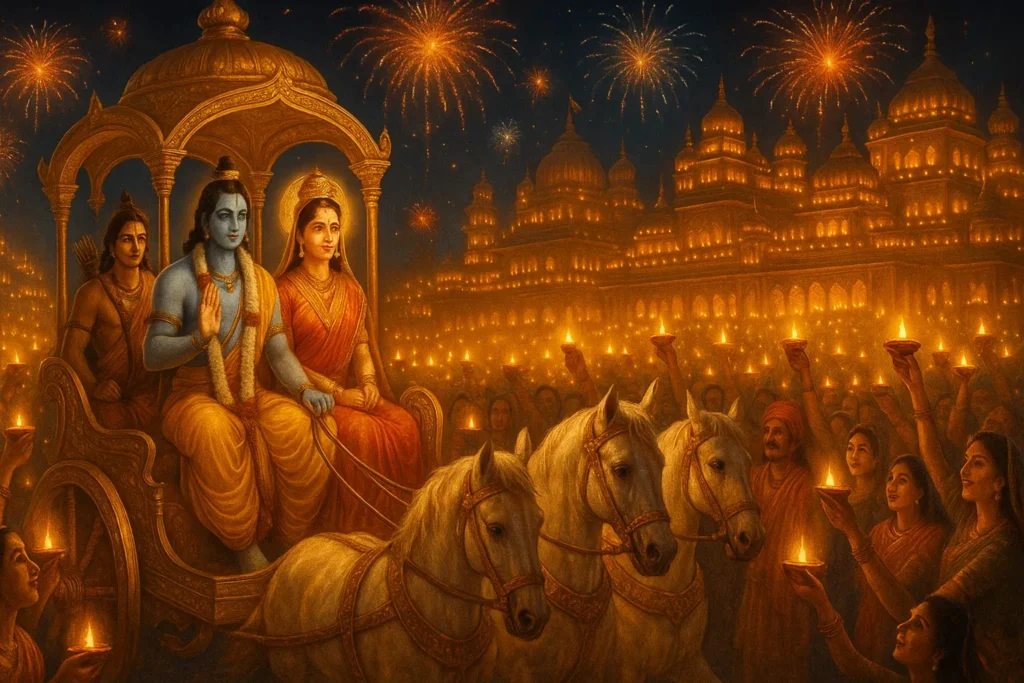
Among all tales, none shines brighter than the homecoming of Lord Rama, the noble prince of Ayodhya. After fourteen long years of exile and an epic battle against the demon king Ravana, Rama returned victorious, accompanied by his devoted wife Sita and his loyal brother Lakshmana.
As the story goes, the people of Ayodhya — overwhelmed with joy — lit countless lamps to welcome their beloved prince home. The entire city glowed like a river of light, symbolizing not just the end of exile but the victory of righteousness over evil.
This legendary celebration became one of the most revered mythological origins of Diwali, marking the triumph of dharma (righteousness) and the restoration of peace. Even today, families light rows of diyas, believing that these gentle flames guide goodness and divine blessings into their homes.
Interestingly, in the deeper spiritual sense, Rama is seen as an incarnation of Vishnu, while Sita represents Lakshmi, the goddess of prosperity. Their reunion on that moonless night was symbolic — the return of divine balance and fortune to the world.
Diwali, derived from Deepavali — “a row of lights” — thus began as a celebration not merely of a king’s return but of the universe’s restored harmony.
The Rebirth of Goddess Lakshmi: Light Returns to the Cosmos
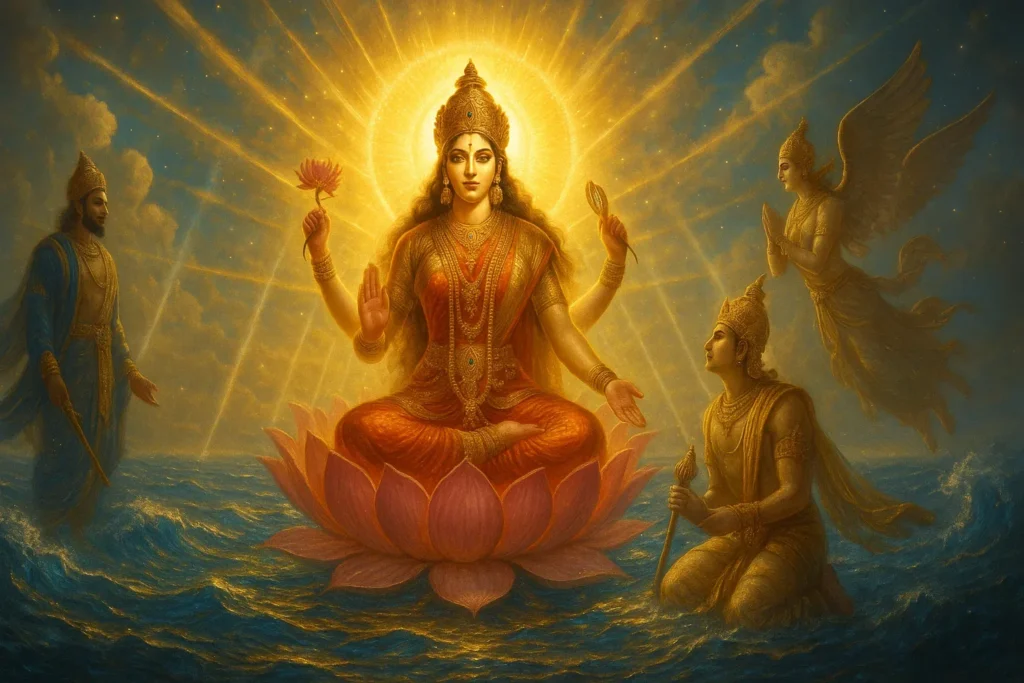
While Rama’s tale unfolds in an earthly kingdom, another legend places Diwali in the very heart of the cosmos — the story of Goddess Lakshmi’s rebirth.
According to ancient lore, pride once overtook Indra, the king of the gods. Offended by his arrogance, Lakshmi — the goddess of wealth, fortune, and light — vanished into the depths of the cosmic ocean, the Ksheera Sagara. With her departure, prosperity and joy vanished from all realms, and the universe fell into darkness.
Desperate to bring back her radiance, gods and demons formed an unlikely alliance. Together they performed the Samudra Manthan — the churning of the ocean of milk — in search of her return. For eons, they toiled, using a mountain as their churning rod and a mighty serpent as the rope.
Finally, on the new-moon night of the month of Kartik — the very night celebrated as Diwali — Lakshmi emerged, resplendent upon a lotus, blessing the worlds once more with abundance and light.
The gods rejoiced, lighting lamps to honor her return, and humans followed their divine example. Thus, the mythological origins of Diwali became forever linked with Lakshmi’s emergence. On Diwali night, devotees perform Lakshmi Puja, adorning homes with lamps and rangoli to welcome her grace and prosperity.
Beyond mythology, the story holds a metaphorical truth — just as the ocean was churned to recover Lakshmi, we too must churn our hearts and minds to rediscover our inner light and humility.
Krishna and Narakasura: Liberation from Darkness
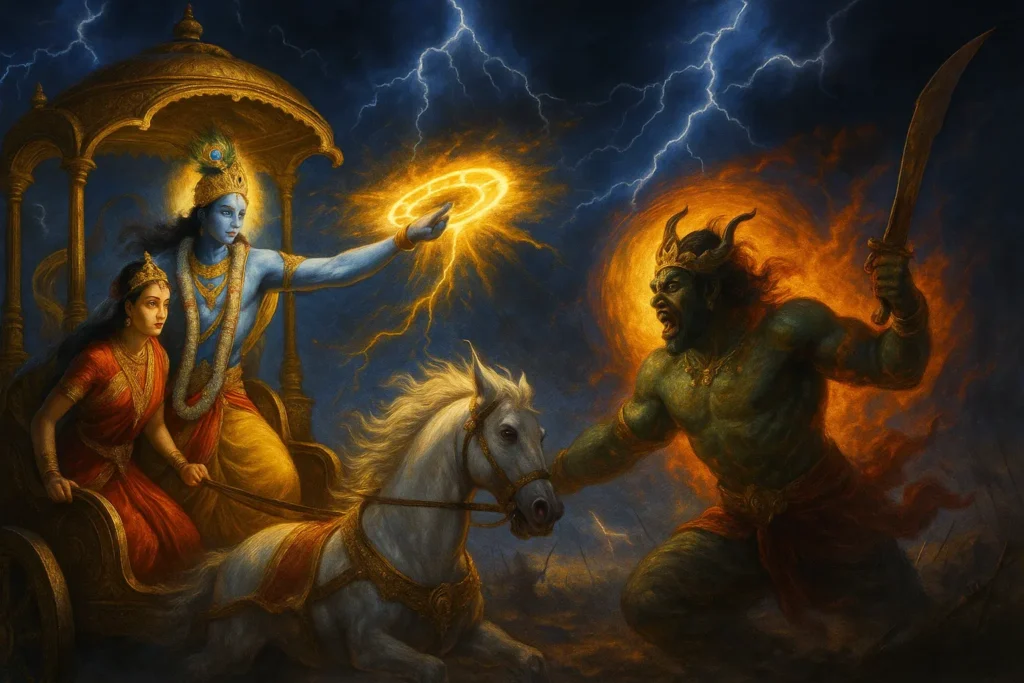
In the southern parts of India, the festival carries another tale — one of courage and deliverance. It tells of Lord Krishna’s battle with the tyrant Narakasura, a cruel demon king who imprisoned thousands and spread terror across the land.
Unable to bear his atrocities, the people prayed for salvation. Responding to their cries, Krishna, accompanied by his wife Satyabhama, set out to end the demon’s reign.
A fierce battle raged through the night. Narakasura, protected by a boon that only his mother could kill him, fought savagely. But fate turned when Satyabhama — the reincarnation of his divine mother, Bhudevi — struck him down, fulfilling the prophecy.
As he lay dying, Narakasura asked that his death be remembered not with mourning but with joy. Let lights and laughter fill the world, he said, for his fall marked the dawn of freedom.
His wish was honored. The next morning was celebrated as Naraka Chaturdashi, a prelude to Diwali. People bathe in fragrant oils, burst firecrackers, and light diyas to mark the end of fear and the rise of light.
This legend’s mythological origins of Diwali speak of liberation — of chains broken and courage restored. It reminds us that even the darkest tyranny can end with one act of divine justice.
Vishnu and King Bali: The Lesson of Humility
From the southern shores, we move westward to the story of King Bali — a tale that teaches humility over pride.
King Bali, though an asura (demon) by birth, was renowned for his virtue and generosity. His power grew so immense that he conquered the heavens, unsettling the cosmic order. The gods, in desperation, turned to Vishnu for help.
But Vishnu did not appear as a warrior. Instead, he descended as Vamana, a humble dwarf monk, to test Bali’s heart. Approaching the mighty king during a sacred ritual, Vamana asked for a simple gift — three steps of land.
Bali laughed and agreed. To his astonishment, Vamana began to grow — taller than mountains, larger than the sky. With one stride, he covered the earth; with the second, the heavens. When no space remained for the third, Bali bowed and offered his own head. Vishnu placed his foot upon it, sending the king to the netherworld but blessing him for his humility and devotion.
Vishnu granted Bali a boon — to return once each year to visit his people. This day, known as Balipratipada, falls just after Diwali and is celebrated with lamps, gifts, and songs of remembrance.
Through this story, the mythological origins of Diwali remind us that the true light lies not in victory, but in surrender to righteousness. Bali’s humility became his eternal glory, and the lamps lit in his honor symbolize selflessness and devotion.
The Pandavas’ Return and Kali’s Triumph
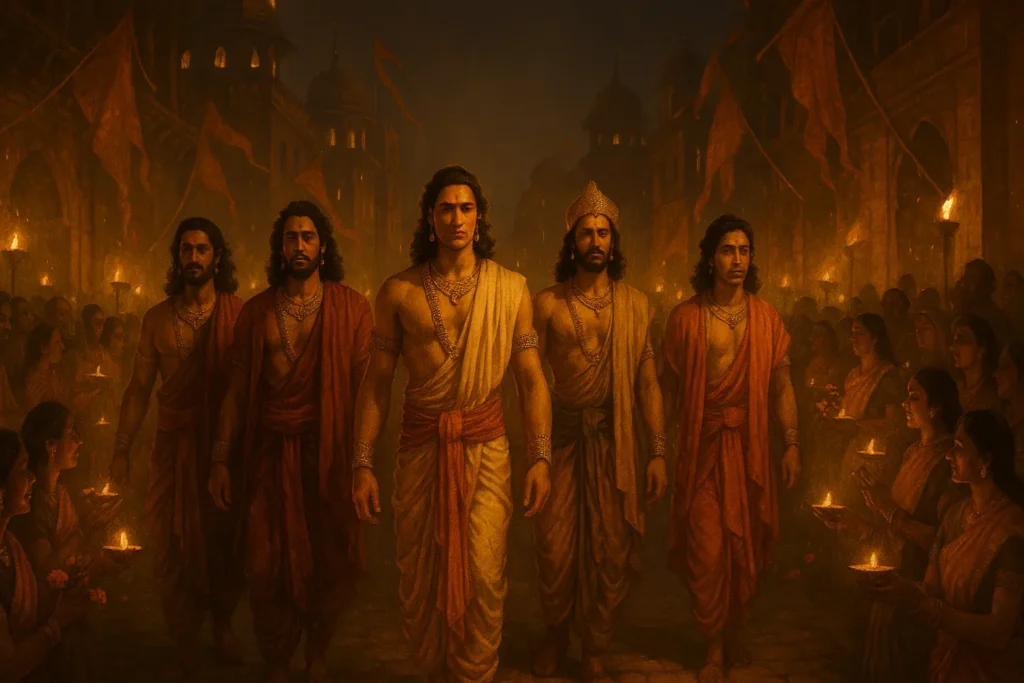
From the pages of the Mahabharata comes another chapter in Diwali’s mythic tapestry — the return of the five Pandava brothers. After thirteen years of exile and countless trials, they returned home on a moonless Diwali night. Their loyal subjects, overjoyed, illuminated the streets with earthen lamps, celebrating the restoration of justice and the end of oppression.
This homecoming became one of the mythological origins of Diwali, symbolizing hope renewed and righteousness reclaimed. Just as Ayodhya glowed for Rama, Hastinapura gleamed for the Pandavas — both cities united by light conquering darkness.
In Bengal, however, Diwali takes a fierce and awe-inspiring form — Kali Puja. Here, the night honors the dark goddess Kali, born from the wrath of Durga to destroy the demon Raktabija, whose spilled blood created endless clones of himself.
To defeat him, Kali drank every drop before it touched the ground, devouring his army and saving creation. Yet her victory dance grew so wild that the universe trembled until Lord Shiva lay at her feet to calm her fury.
In this powerful story, the mythological origins of Diwali become a celebration of divine feminine power — the force that destroys darkness to protect creation. The lamps of Kali Puja glow not just with reverence, but with gratitude that such fierce love exists in the universe.
Weaving the Tapestry of Light
Across India and beyond, the mythological origins of Diwali weave together into one magnificent fabric of faith, devotion, and human emotion. Each tale — from Rama’s return to Lakshmi’s rebirth, Krishna’s victory to Bali’s humility, the Pandavas’ homecoming to Kali’s divine rage — reveals a different shade of the same truth: light always finds a way back.
In every region, in every heart, Diwali tells us that darkness is never permanent. Hope endures. Goodness prevails. And every lamp lit on this sacred night is an echo of those ancient moments when the world rediscovered its light.
The Deeper Meaning Behind the Festival of Lights
Beyond myth and ritual, Diwali speaks to the human spirit. It reminds us to:
- Let go of pride, like Indra and Bali.
- Stand for righteousness, like Rama and the Pandavas.
- Seek inner light through humility and reflection.
- Celebrate courage and compassion over fear and greed.
The mythological origins of Diwali are not frozen in the past; they live on each time we light a diya or forgive a wrong. They whisper that every soul has its own darkness to overcome — and every victory, no matter how small, deserves a flame.
A Night That Connects Generations
When families gather under the glow of lamps and fireworks, when laughter fills the air and prayers rise with incense, we are not merely celebrating a festival. We are retelling a story as old as time.
The stories of Diwali — of gods who descended to earth, of kings who learned humility, of goddesses who restored balance — remind us of who we are and what we aspire to be. As the diyas flicker on windowsills, they echo an ancient promise: that light, once kindled, can never truly die.
And perhaps, that is the most beautiful of all the mythological origins of Diwali — the belief that no matter how deep the night, the dawn of goodness will always rise again.