
Introduction
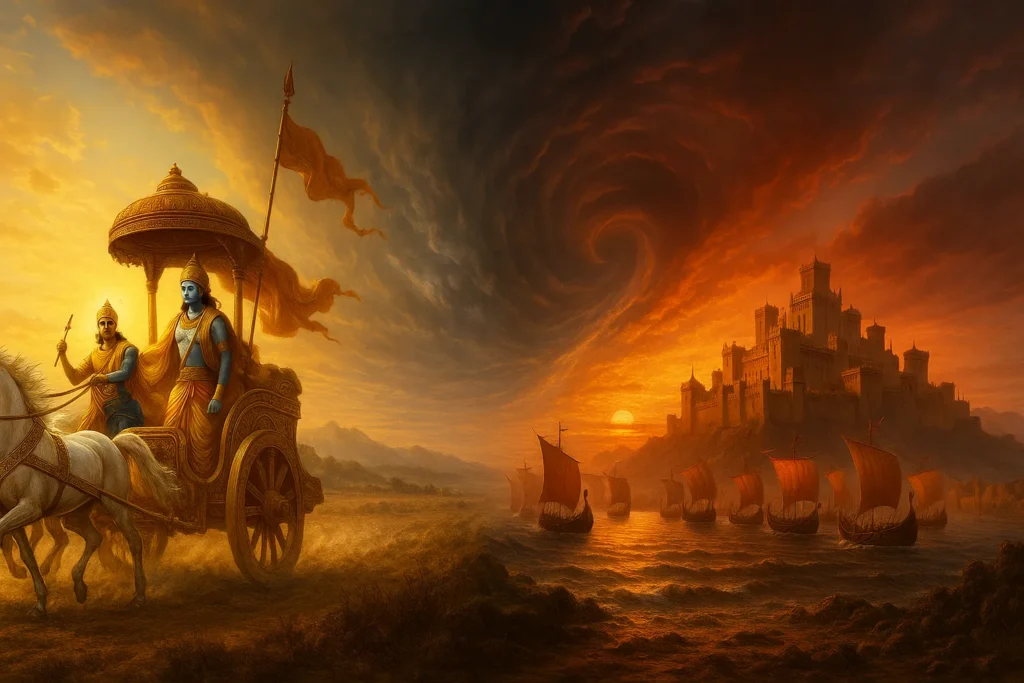
Across the sweep of history, few legends rival the grandeur of the Kurukshetra vs Trojan War — two epic battles, one from India’s Mahabharata and the other from Greece’s Iliad, that have captivated humanity’s imagination for millennia.
One was fought on the sacred plains of India, where cousins turned enemies over dharma and destiny.
The other raged along the golden walls of Troy, where kings, heroes, and gods battled for honor and love.
Separated by continents, yet united by spirit — both wars explore what it means to fight for what one believes in, to question fate, and to confront the divine.
In this exploration of Kurukshetra vs. Trojan War, we’ll uncover their shared motifs — from divine intervention to moral conflict — and discover how these two epics, though born from different worlds, whisper the same truths about the human soul.
Causes of War: Honor, Duty, and Destiny
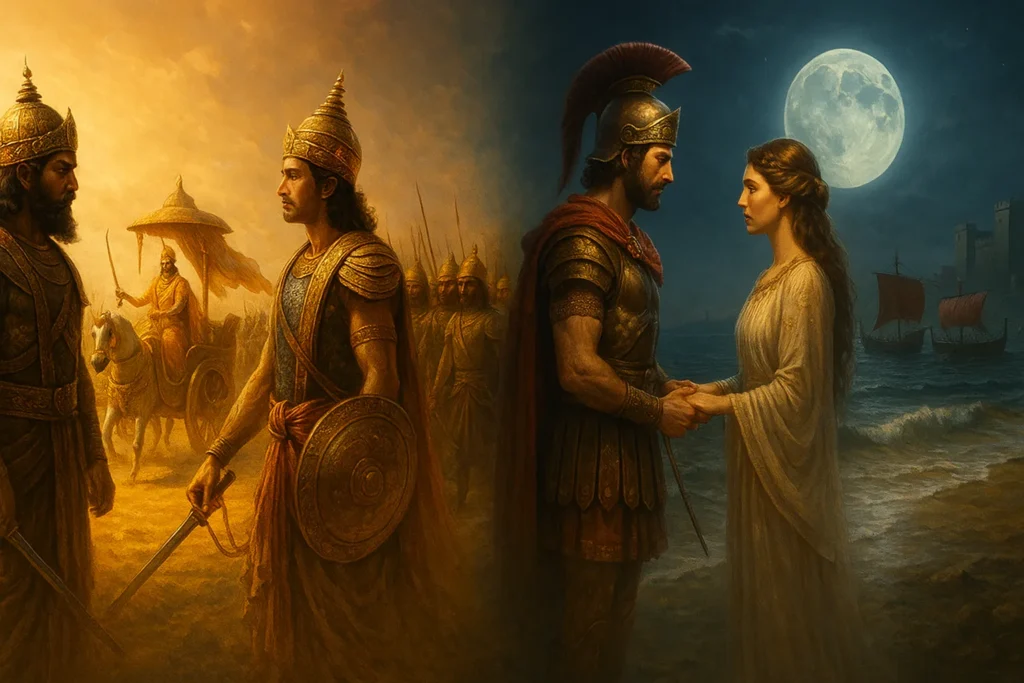
At the heart of both wars lies a struggle between righteousness and pride, duty and desire.
The Kurukshetra War began as a family feud within the Kuru dynasty.
The Pandavas, exiled and humiliated after a rigged dice game, sought justice and the return of their rightful kingdom.
When diplomacy failed, Lord Krishna himself went to Hastinapura as a messenger of peace, offering even five villages.
But Duryodhana, blinded by arrogance, declared he would not give even “the space a needle can pierce.”
Thus began the war destined to end an age — the Dvapara Yuga.
The Trojan War, on the other hand, was ignited by love and betrayal.
When Paris of Troy carried away Helen, the wife of Menelaus, it was not just a romantic scandal — it was an insult to Greek honor and the sacred laws of hospitality.
Bound by oath to protect Helen, the Greek kings united under Agamemnon and sailed to Troy with a thousand ships.
Yet behind the surface of passion lay divine design — prophecies foretold that Troy must fall, and the gods themselves conspired to end the “Age of Heroes.”
Thus, the Kurukshetra vs. Trojan War comparison begins with a shared foundation: both wars were born from ego, fate, and the unraveling of cosmic order.
Legendary Heroes: Mirrors Across Civilizations
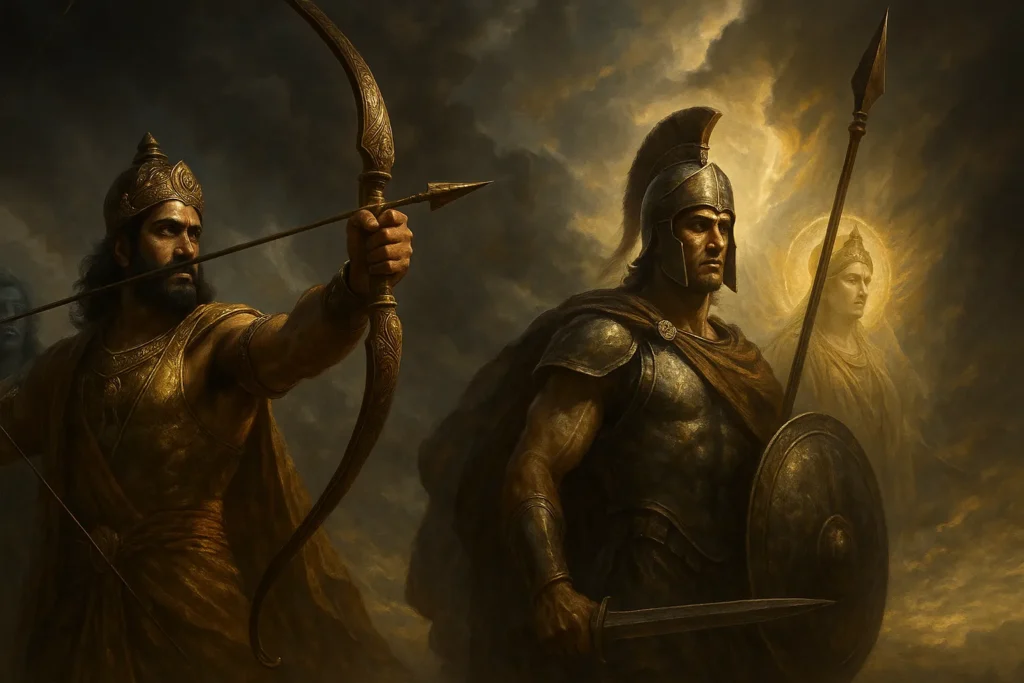
Every great war forges heroes who become eternal symbols of human nature.
Both the Mahabharata and the Iliad assemble warriors of unmatched might, wisdom, and tragedy — each reflecting the other’s essence.
In Kurukshetra stands Arjuna, the master archer torn between duty and compassion, guided by Krishna’s divine wisdom.
Opposite him is Karna, the tragic son of the Sun God, cursed by fate yet unmatched in honor and generosity.
Bhima, with his thunderous strength, and Yudhishthira, the just king, complete the Pandava line.
Facing them are Bhishma, bound by his vow, and Drona, the teacher torn between loyalty and justice.
In Troy stands Achilles, peerless in combat but consumed by pride; Hector, noble defender of his city; Odysseus, cunning and eloquent strategist; and Ajax, a mountain of muscle and valor.
The parallels are profound:
- Arjuna and Achilles both hesitate to fight — one due to moral conflict, the other due to wounded pride.
- Karna and Hector are doomed champions, noble yet bound to the wrong side by duty and loyalty.
- Krishna and Odysseus act as divine strategists, turning wisdom into weaponry.
- Bhima and Ajax, both giants of their armies, fight with raw power and righteous fury.
Through these heroes, we glimpse the universal archetypes of mythology — the warrior torn by conscience, the hero fated to die young, the wise counselor who moves worlds without a sword.
Gods in the Kurukshetra vs. Trojan War — When Heaven Interferes
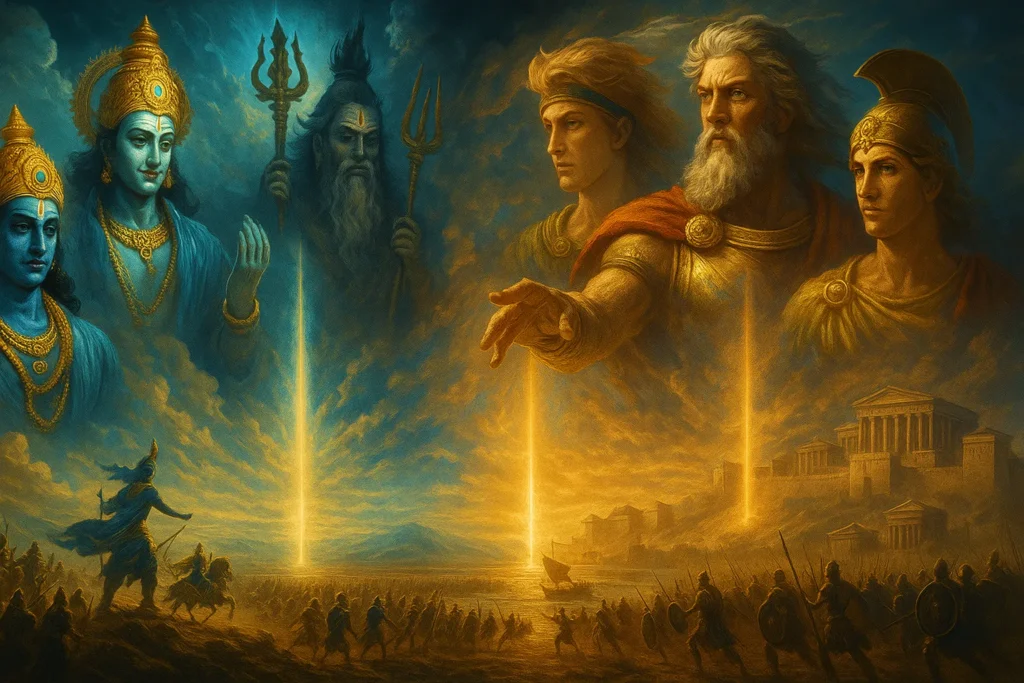
Both epics blur the line between heaven and earth, where gods step down from their realms to shape mortal destiny.
In the Mahabharata, Lord Krishna is not just Arjuna’s charioteer — he is the cosmic consciousness itself, guiding mankind toward dharma.
Other gods, too, weave through the narrative: Indra grants divine weapons, Shiva bestows boons, and curses ripple across generations.
Even fate itself is personified — destiny, karma, and divine justice intertwine like threads on the loom of creation.
In the Trojan War, the Olympian gods act with all-too-human emotions.
Zeus balances fate but cannot resist meddling; Athena, Hera, and Poseidon fight for the Greeks; Apollo, Ares, and Aphrodite defend Troy.
The gods quarrel, deceive, and even wound each other, proving that divinity, too, mirrors human flaw.
Thus, the Kurukshetra vs. Trojan War contrast reveals a fascinating difference:
In India, the gods guide mortals toward enlightenment; in Greece, they mirror human folly — yet both serve the same cosmic truth that no war is ever just human.
Strategy and Deception — When Dharma Meets Cunning
The greatest wars are not won by muscle alone, but by mind and moral paradox.
The Mahabharata is full of divine strategies disguised as moral dilemmas.
Bhishma, invincible due to his boon, falls only when Arjuna uses Shikhandi, born female in a past life, to face him.
Karna’s downfall comes through Krishna’s orchestration — his chariot wheel stuck, his memory of mantras lost, his fate sealed.
Even Jayadratha’s death, caused by Krishna’s illusion of sunset, becomes a testament to divine cunning serving cosmic justice.
The Trojan War echoes the same cleverness.
When brute force fails after ten long years, Odysseus conceives the ruse of the Trojan Horse, bringing ruin through deception disguised as devotion.
Both Krishna and Odysseus prove that wisdom, not weapons, determines victory.
Each war also teaches a grim truth: even righteous causes require compromise, and even the divine bends the rules of war when fate demands it.
Kurukshetra vs. Trojan War — The Aftermath of Victory
Victory came at an unbearable price in both epics.
In Kurukshetra, eighteen days of slaughter annihilated nearly every warrior clan of Bharat.
The battlefield became a wasteland of bodies, with rivers of blood and ashes of valor.
The Pandavas, though victorious, ruled with sorrow.
Yudhishthira’s coronation felt hollow; his conscience heavy with the cries of kin.
Finally, renouncing his throne, he walked toward the Himalayas with his brothers — seeking peace beyond victory.
In Troy, the flames of ruin consumed the proud city.
Achilles fell to Paris’s arrow, guided by Apollo; Hector’s son was hurled from the battlements; Priam begged for mercy at his conqueror’s feet.
Odysseus wandered for years, punished by the very gods he once served.
The Heroic Age ended, and mankind entered a lesser time — an echo of India’s transition from Dvapara to Kali Yuga.
Thus, both wars mark the end of an era — where divine ages yield to human struggle, and wisdom rises from the ashes of pride.
Lessons and Reflections — The Universal Truths of War
When comparing the Kurukshetra vs. Trojan War, we uncover timeless lessons that transcend geography:
1. War Is a Mirror of the Soul
Both Arjuna and Achilles fought not just enemies, but their own inner chaos. The true battleground lies within.
2. Divinity Doesn’t Guarantee Righteousness
The gods in both cultures intervene — sometimes to uphold order, sometimes to fuel destruction. Their actions reflect the duality of existence.
3. Victory Demands Sacrifice
Every triumph leaves emptiness behind. Both Yudhishthira and Odysseus return to silence — haunted, not heroic.
4. The Cycle of Time Is Eternal
As Troy and Kurukshetra fell, so too will every age end — reborn anew, guided by the same eternal struggle between dharma and desire.
Conclusion: Two Epics, One Eternal Wisdom
In comparing Kurukshetra vs. Trojan War, we find that mythology is humanity’s mirror — reflecting our noblest ideals and darkest temptations.
Both wars reveal that truth and tragedy walk hand in hand, and that divinity often speaks through destruction.
Arjuna’s doubt and Achilles’s rage, though born in different worlds, express the same human anguish — the question of purpose in a world ruled by fate.
When we read the Mahabharata or the Iliad, we’re not just revisiting ancient wars — we’re witnessing the timeless dance of pride, devotion, and destiny.
And perhaps, through these two mirrors — one Vedic, one Hellenic — we glimpse the oldest lesson of all:
The gods may fight beside us, but peace can only be found within us.
Written by Team Vedic Wars — exploring the cosmic wisdom of India’s epics and Vedic history.